
As summer turns to fall, bears become an increasingly familiar presence on the landscape here in the Basin. For me, that means the walk home from work comes with a little more awareness. The other evening, as I made my way toward my house tucked into the aspens, I spotted a lone male grizzly, or boar, digging steadily into the ground just a few yards from my porch. This time of year, grizzlies enter a period called hyperphagia, when they become intensely focused on eating as many calories as possible before winter.
Two plants help explain all that digging: yampah and caraway.
Yampah (Perideridia gairdneri) is a native perennial in the carrot family found across parts of the West, including Montana. It produces small, edible tubers and has long been an important traditional food for Indigenous peoples. Yampah is important to bears, too. Its roots are a documented fall food for grizzly bears in the Greater Yellowstone Ecosystem, providing valuable energy before winter. However, its small, scattered roots require bears to spend considerable time and energy searching and digging.
An invasive biennial originally found in Europe, Asia, and North Africa, wild caraway (Carum carvi) was introduced to North America as a culinary spice and now grows widely in Montana, particularly in pastures and other disturbed areas. Unlike yampah, caraway can form dense stands, allowing a bear to keep digging in one productive patch rather than searching for scattered roots.
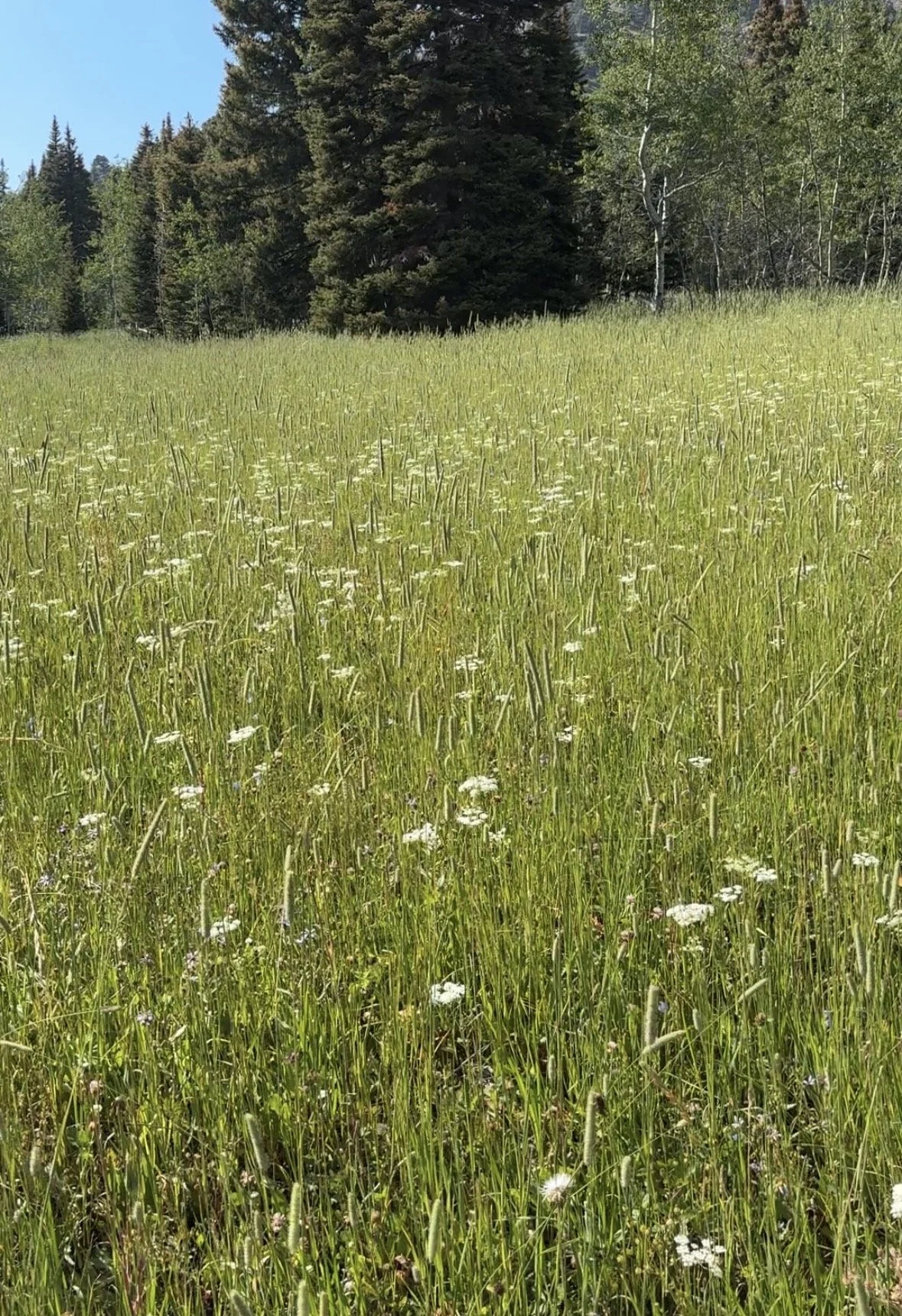
A field of caraway pictured in white.
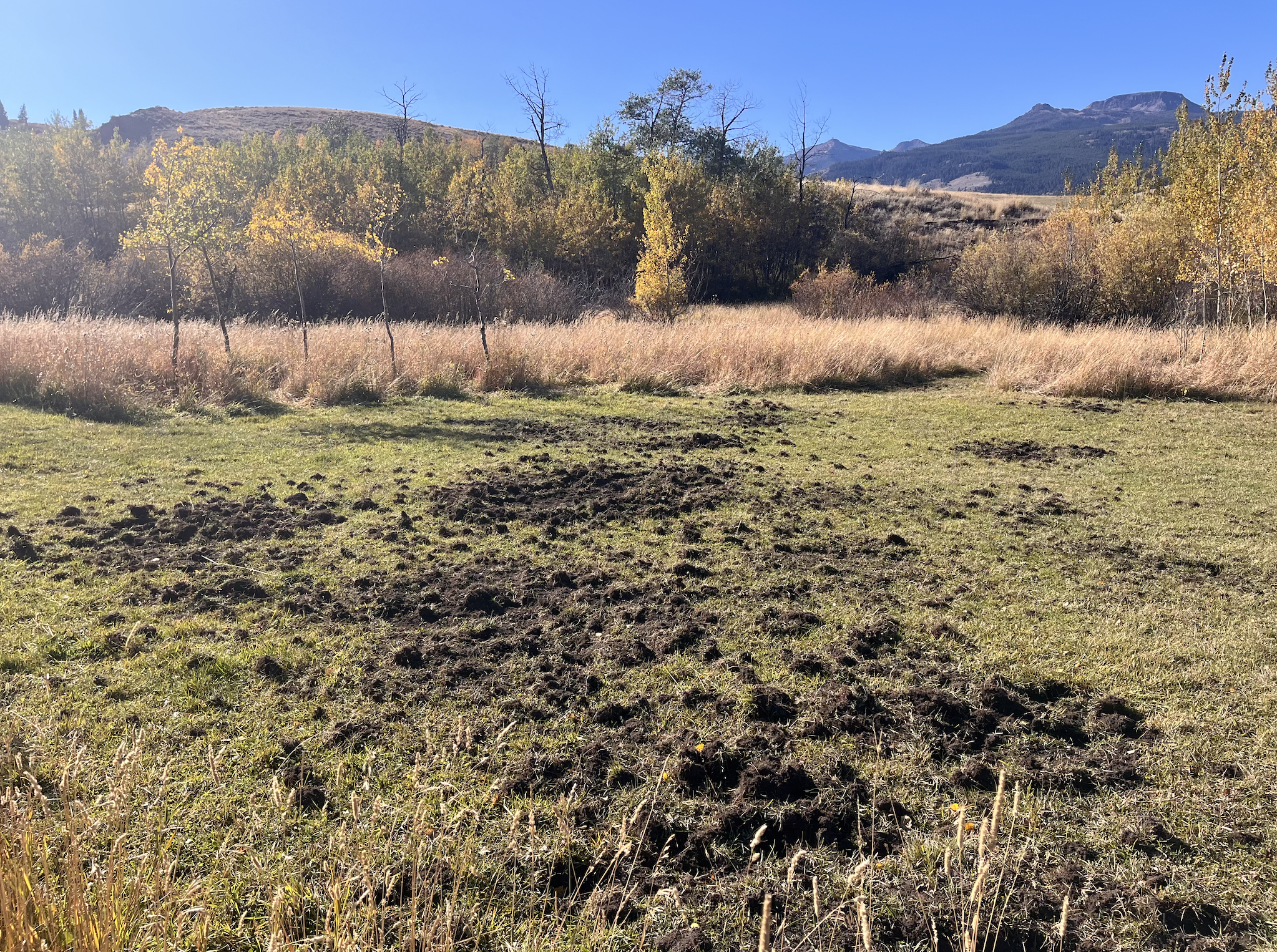
Evidence of bear dig.
We often think of grizzlies as mountain animals, but that is not their whole history. In Montana, they once occupied much of the plains and eastern part of the state before settlement pushed them into more remote country. That creates an interesting tension here in the Basin. The same open, productive landscapes that provide abundant food for bears are also where people live and work, placing humans and wildlife in proximity.
As I sit at my table watching the bear slowly disappear into the willows, I start thinking about what coexistence really means in the West. Not to get too sappy on you, but nights in an off-grid tiny house tend to invite a little introspection. Watching that bear dig, I started wondering what I might need to unearth in my own consciousness.
We usually think of wildlife as moving through our landscape, when really, we are constantly altering theirs. Here in Tom Miner Basin, coexistence means making room for all of us to thrive and survive, not picking and choosing what is convenient. I’m reminded of one of my favorite quotes from Edward Abbey’s Desert Solitaire.
“When I write 'paradise' I mean not only apple trees and golden women but also scorpions and tarantulas and flies, rattlesnakes and Gila monsters, sandstorms, volcanoes and earthquakes, bacteria and bear, cactus, yucca, bladderweed, ocotillo and mesquite, flash floods and quicksand, and yes – disease and death and the rotting of the flesh.”
Abbey’s vision of paradise isn’t sanitized. It’s not that I particularly enjoy the adrenaline rush of spotting a grizzly between me and my front door, but I am pro-biodiversity. When I think about the fences, roads, and buildings wildlife navigate every day, waiting a few extra minutes feels like a pretty small price to pay.
Part of why I started working in the ranching industry is because I am deeply nostalgic for the old West. In college, I found myself drawn to stories like Lonesome Dove and All the Pretty Horses, with their wide-open country and characters who seemed to move through the landscape on their own terms. I still love those stories, but I think we need to complicate them. Maybe the modern West is not about deciding whose story belongs, but making room for more of them.
The histories of Indigenous peoples, Western settlers, and ranching communities are all part of this place, but so are the stories of the bears, elk, rivers, grass, soil, and livestock. We are not the only ones shaping this landscape, and we are not the only ones with a story to tell.
The bears have a funny way of making that impossible to forget. When I encounter one, I become deeply present on the land. I pay attention to where I am, what is around me, and what I am doing. There is not much room for ego when a grizzly is digging beside your porch. You become aware of yourself as one small part of something much larger.
A sow and her cubs spotted digging.
Coexistence asks us to dig a little deeper. Bears do it literally, tearing into the soil to find what they need. We might need to do something similar with the stories we have inherited about the West: dig beneath old ideas of domination and rugged individualism, turn them over, and decide what is worth carrying forward.
Large carnivore conflict brings this tension into focus. It is easy to turn a bear and a rancher into opposing sides. But coexistence asks us to see ourselves as part of a larger system rather than in control of it. When we step onto the land, we are entering a system that was here long before us.
There is no hero on this landscape.
Written by: Belle Brown, Tom Miner Basin Association’s 2026 Bear Ambassador/Coordinator