
When I was a junior at Bozeman High School, my English class was asked to write about whether people are inherently good or evil. Are we shaped by our environment, or born with the morals that guide us? After much deliberation, I put down my copy of Lord of the Flies and wrote: evil.
For much of my life, our cultural and economic systems made me feel that humans were inherently bad for the planet. In college, I taught Leave No Trace principles for our recreation center and encouraged the idea that humans should leave as little evidence of their presence as possible. There is obvious value in protecting fragile places from destruction. But the philosophy sometimes left me with the impression that humans were fundamentally out of place in nature, temporary visitors who should strive to become invisible.
Eventually, I began wrestling with a harder question: How do we treat our relationship with the land as an active partnership rather than simply a list of restrictions?
These last few weeks, I have watched the Basin explode with activity. Tour buses whip past my four-wheeler. Cars park with their doors ajar as families spill onto the dirt road. Vehicles tailgate one another in a steady procession toward the “bear spot,” where they are given a safe place to pull off the road. Dust coats my skin, fills my mouth, and settles over residents’ homes in a thick cloud. Last night, I watched two terrified elk scatter back and forth before finally making a run for it across the road.
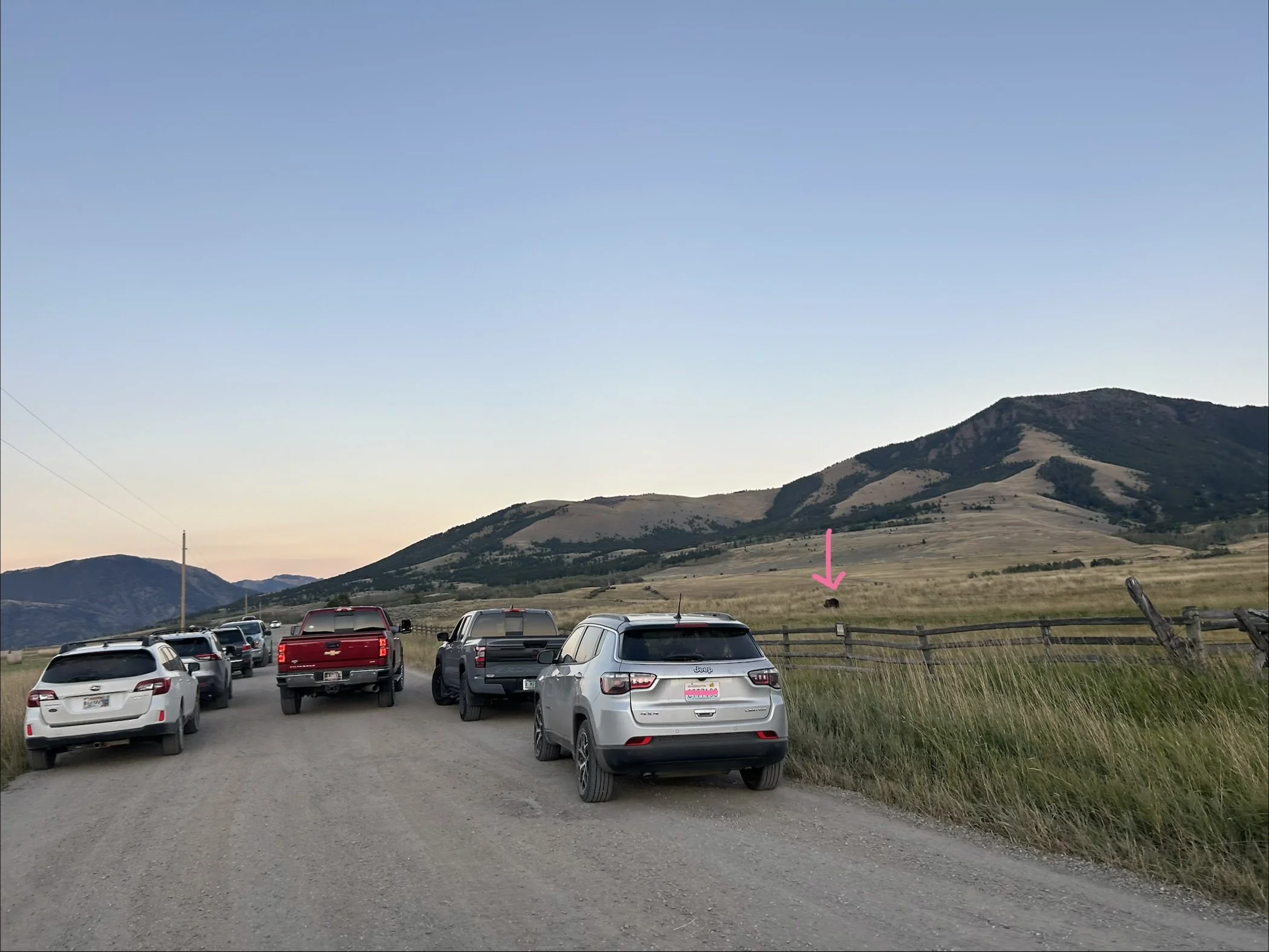
Lone grizzly surrounded by vehicles.
For the people who live here and for the wildlife that moves through this important corridor, these effects have been negative. But sometimes I wonder…is telling people they cannot experience something I love the wrong answer? Am I selfish for wanting this place to remain quiet?
The first time I felt I had encountered an answer that made room for both people and the land was after hearing Robin Wall Kimmerer speak at my college in Missoula.
Kimmerer’s idea of the honorable harvest offers a different framework for thinking about our relationship with the natural world. Taking from the land is not inherently wrong. What matters is how we take. Consumption becomes an act of relationship, governed by restraint, gratitude, and reciprocity. As visitors continue to inch closer to the bears even when their presence contributes to habituation and wildlife stress, our restraint slips away.
She also challenges the idea that humans must be a net-negative force. Every species has a role to play in an ecosystem, and humans are no exception. The question, then, is not simply whether we belong, but what kind of presence we choose to be.
We take so much from the Earth. What do we give back? When someone speeds into the Basin to take a photograph of a bear and then turns around, what could I tell them that would make them feel connected to this place, and therefore responsible for it?
I still believe that getting people to care about wild places is one of the strongest forms of conservation. People protect what they love. But I am beginning to understand that love, by itself, is not enough.
This morning, I watched a line of cars gather around a single bear digging in a field. I went home discouraged, wondering how I could reach all of these people. How do I understand their desire to see something extraordinary while also asking them to recognize the consequences of that desire?
Wendell Berry, another favorite writer and agrarian of mine who passed recently, argued in his essay Think Little that meaningful change rarely begins with grand solutions. It begins with small, local acts of care, with knowing a place well enough to notice when something is wrong and taking responsibility for the world directly in front of you.
I try to remember that when I feel overwhelmed by the traffic in the Basin.
I think we are capable of being remarkably destructive and remarkably caring. Perhaps the difference lies in whether we see ourselves as separate from the places we inhabit or as participants in them. September in the Basin has left me feeling conflicted. However, I’m inspired to see how the Tom Miner Basin Association can continue to discover what makes people care enough to change their behavior and feel connected to a place they might not call home.
“To love a place is not enough. We must find ways to heal it.”
— Robin Wall Kimmerer, Braiding Sweetgrass
Written by: Belle Brown, Tom Miner Basin Association’s 2026 Bear Ambassador/Coordinator